
Viking Objects
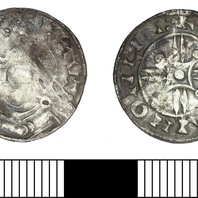
Coin of Cnut the Great (DENO-28F8A6)
This silver penny is a posthumous issue of Cnut, with arm and sceptre obverse type, minted by Thurgrim in Lincoln under the authority of King Harthacnut. Minting coins was a way of controlling the means of exchange within a kingdom and which created a more easily administered standardized system of trade. Moreover, the coins themselves were often used as propaganda, portaying symbols and statements that gave off a desired message. The Vikings later used the minting of coins to legitimize their own rule.
Read More
Viking Objects
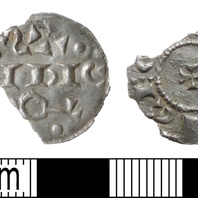
Incomplete Viking Silver Penny (DENO-7A0AF7)
An incomplete silver early medieval penny of the Vikings influenced by the Swordless St Peter type and possibly minted in the name of Sihtric Caoch who ruled Dublin between 917-920 CE and was King of Northumbria from 921-927 CE. It is not certain why he left Ireland. The Irish annals state that it was ‘through the grace of God’ and do not elaborate on the politics behind his departure. After the establishment of the Danelaw, some Viking leaders decided to mint their own coins to solidify their legitimacy in the eyes of the local populace. This created a hybrid economy where some members of the Danelaw used bullion and others used coins.
Read More
Viking Objects
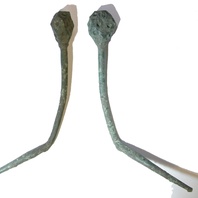
Ring-and-Dot Pin (1986/976-SF4)
This copper alloy pin with a ring-and-dot pattern on the head was used for fastening cloaks. It was found on the site of Little Chester Roman fort. Pins like this were common in Ireland and the western British Isles, and spread further afield under Viking influence.
Read More
Viking Objects
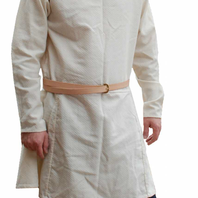
Reproduction Men’s Clothing Set
The woollen tunic is in white broken diamond twill. Few Viking Age woollen tunics survive intact, but a number of large pieces of skirts and side gores, and arm-hole and sleeve pieces were found at Hedeby, in Denmark. This tunic is made from a composite of all these fragments. The woollen trousers are dark blue/grey herringbone twill. These are based on the archaeological remains of the crotch of a pair of baggy trousers, found at Hedeby, in Denmark, which also appear on a number of Viking Age stone carvings across the Viking world, but particularly in Sweden. The woollen leg-bindingins are yellow herringbone twill, based on original fragments from Hedeby, in Denmark. The vegetable-tanned leather belt, with a ring-and-dot decorated brass buckle, is based on an original found in a male grave (Grave 511), at Repton, Derbyshire.
Read More
Viking Objects
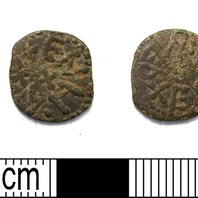
Northumbrian Styca (LEIC-0D9D6F)
This Northumbrian styca was probably minted in the name of Æthelred II of Northumbria possibly by the moneyer Eanwulf. While Wessex and Mercia were using silver coinage as part of their monetary economy, Northumbria was using copper coins known as stycas, which may have contained trace amounts of silver. The concentration of these coins at sites such as Torksey and ARSNY (‘a riverine site near York’) suggests that they could have remained in circulation after the fall of Northumbria in 866 but were taken to these sites by the Vikings during their campaigning. This particular example was likely brought to Nottinghamshire from Northumbria by means of the Great Army’s overwintering activities in and around Nottingham.
Read More
Viking Objects
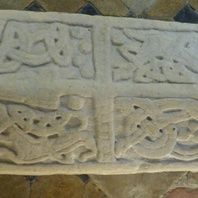
The Hickling Hogback
The Hickling hogback is a type of Anglo-Scandinavian grave cover in St Luke’s Church, Hickling, Nottinghamshire. It is the most southerly grave cover of this type in England. It appears to have been carved from the remains of a Roman column, hence the notch in the end of it. The stone features Scandinavian Jelling-style decoration indicating an expression of Scandinavian identity and muzzled bears on each end which are thought to be indicators of a pagan identity. However, the stone also features a large cross showing that the commissioners of the carving had a strong interest in expressing the Christian identity of the deceased. As such, this stone is designed to show that the person buried under it was a Christian Scandinavian.
Read More
Viking Objects
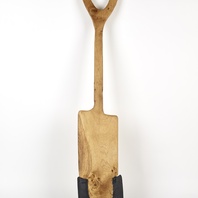
Reproduction Spade
Spades would have had metal shoes to aid with cutting the ground when digging.
Read More
Viking Objects
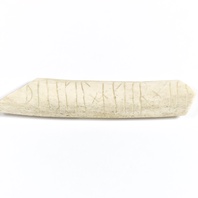
Reproduction Rune Inscribed Rib
Runes were used not only for monumental inscriptions, or to mark ownership of valuable objects, but also in more informal contexts. In this case the animal bone suggests an after-dinner pastime after a good meal in the Anglo-Scandinavian trading centre of Lincoln. The runes read ——l × hitir × stin × … Only two words of the Old Norse inscription can be read with certainty, and even so they are ambiguous. One possible interpretation is ‘[someone] is heating a stone’ the other is ‘[someone] is called Stein’. The bone is fragmentary, but the inscription may never have been intended to make much sense. The original object dates from around the tenth century. It is one of only three runic inscriptions from the East Midlands.
Read More
Viking Objects
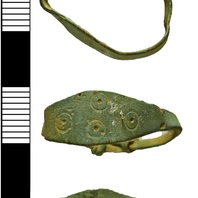
Stamped Finger-Ring (NARC-031C88)
A stamped copper-alloy finger ring decorated with four double ring-and-dots in a lozengiform arrangement. Ring-and-dot was a decorative technique used at various periods from the later Iron Age onwards, but which enjoyed a Viking Age revival. Rings like this with knotted ends are typically Scandinavian.
Read More
Viking Objects
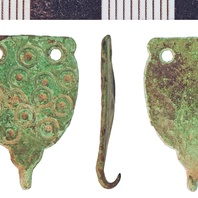
Hooked Tag (NLM-8E96D5)
This example of an Anglo-Scandinavian copper-alloy hooked tag is classed as a Read Class A Type 1 or Class B Type 1. The tag is decorated with a stamped ring-and-dot motif which was a popular style among Scandinavians.